


Table of Contents
- What Fishing Reel Drag Does and Why It Matters
- Finding the Drag Knob on Your Reel
- How Much Drag on a Fishing Reel Should You Set?
- Spinning Reel Drag Adjustment, Step by Step
- How to Measure Reel Drag with a Scale
- Setting Drag on Baitcasting, Fly and Other Reels
- Loosening Your Fishing Reel Drag After Use
- Booking Your Next Trip with the Right Drag Set
- Frequently Asked Questions
What Fishing Reel Drag Does and Why It Matters
Here's the catch most beginners miss. A fish doesn't pull in a steady line.
Good drag also helps you tire a fish out. A smooth, steady drag lets the fish fight itself while you keep the line taut.
The drag is the difference between landing a fish and losing it.
Watch out: setting drag too tight to "stop the fish" is the most common way anglers lose fish.
Finding the Drag Knob on Your Reel
Most spinning reels have the drag knob on the front of the reel, near the spool.
Baitcasting reels put the drag knob on the side of the reel, often near the handle.
Check the reel's markings before you start.
Turning the knob clockwise usually tightens the drag. Anticlockwise loosens it. Always confirm this on your model, since a few reels reverse the direction.
How Much Drag on a Fishing Reel Should You Set?
There's no single correct setting. The right amount depends on your line strength, the fish you're chasing and how hard it pulls.
A common starting point is to set the drag to about a quarter to a third of your line's breaking strength.
Lighter setups need lighter drag.
A common approach is to test the drag before each trip and adjust as you go.
Spinning Reel Drag Adjustment, Step by Step
Spinning reels are a popular choice for beginners. Follow these steps and you'll have drag set in a few minutes.
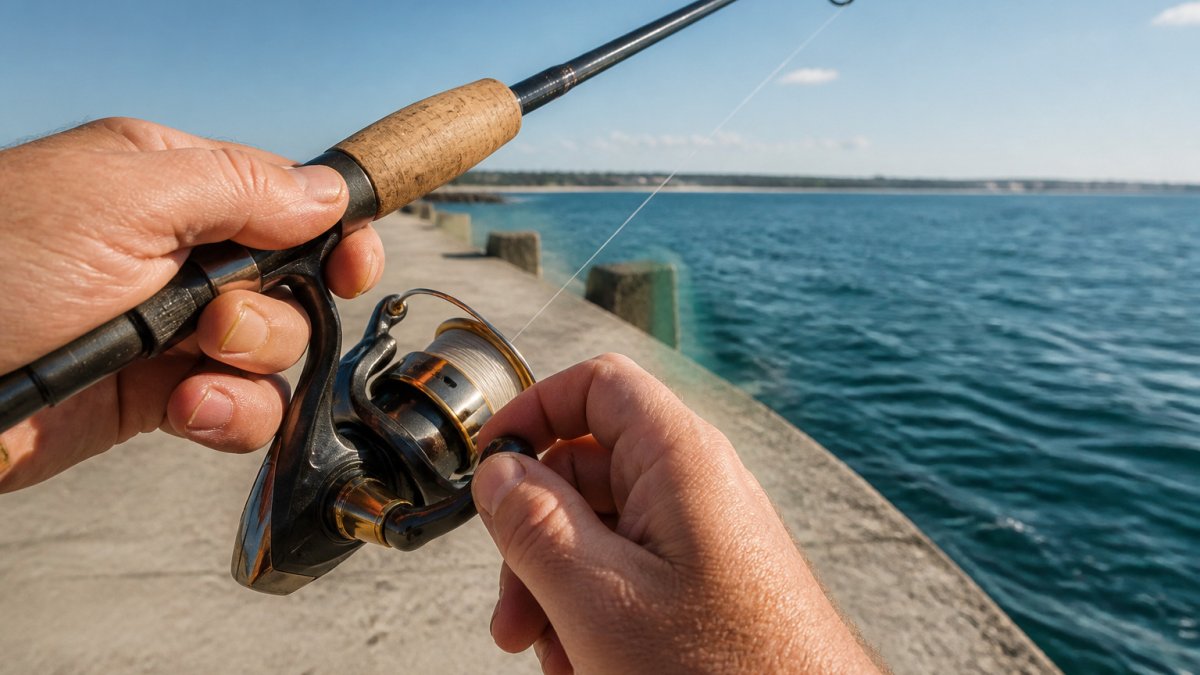
- Tie on your line and lure or hook. Use a leader if your setup calls for one.
- Pull line off the spool until you have enough to hold the rod comfortably.
- Set the drag fully loose by turning the knob anticlockwise until it turns freely.
- Tighten gradually by turning clockwise in small increments, about a quarter turn at a time.
- Test with a steady pull on the line by hand, or by holding the rod tip down, to see whether the line slips.
- Adjust until the line slips at about a quarter to a third of the breaking strength.
- Lock the setting by checking it one more time before you cast.
Expected result: the line should slide off smoothly under a firm pull, not snap or stop dead.
Watch out: never tighten the drag while a fish is pulling hard. Change the setting in small steps during calm moments, or you risk breaking off.
Using the 25 to 33 Percent Rule
A common rule of thumb suggests setting drag to between a quarter and a third of your line's breaking strength.
For example, with 10 kg line, the drag should release at roughly 2.5 to 3.3 kg of pull.
Remember that the breaking strength on the line label is the real limit. Knots and damaged line are weaker, so set your drag with some margin.
How to Measure Reel Drag with a Scale
Feel alone is a rough guide. A handheld scale gives you a repeatable number you can use on every trip, and it turns the 25 to 33 percent rule from a guess into something you can actually verify.
What you need
- A handheld spring or digital scale rated above your intended drag setting (a 10 kg or 20 kg scale covers most light and medium setups).
- A fixed anchor point at roughly rod-tip height, a post, a fence rail, a trailer tie-down, or a sturdy tree branch.
- A short length of cord or a loop of line to connect the scale to the anchor.
The measurement procedure
- Rig as you would fish. Tie on the leader and terminal tackle you plan to use, because knots and leader are often the weakest link and will change the reading.
- Anchor the scale. Hook the scale's loop to the fixed point with the cord, so the scale hangs at about the height your rod tip will be.
- Attach the line. Tie or clip the line to the scale's hook using a plain loop, do not use a knot that weakens the line at the test point.
- Set the drag loose. Back the knob off until the spool turns freely.
- Pull at a steady angle. Hold the rod at roughly the angle you'd fish it (about 45 degrees to the line) and walk backwards slowly, letting line pay out through the guides. Pull smoothly, a jerky pull gives a false high reading.
- Read the slip point. Watch the scale as the drag begins to give line. The number at the moment the spool starts to slip steadily is your drag setting.
- Repeat three times. Take three pulls and average them. A consistent reading within about 10 percent tells you the drag is smooth; a wide spread points to a sticky drag or a worn washer.
- Record it. Note the scale reading and the knob position (for example, "2.8 kg at 4.5 turns from loose") so you can return to it next trip.
Reading the result against your line
Compare the measured slip point to the weakest part of your setup, not just the line's label strength. A 10 kg braid with a knot that tests at 7 kg should be set nearer 2 kg than 3.3 kg. If your scale reads higher than a third of the weakest link, back the knob off a quarter turn and re-test.
When feel is enough
A scale is worth the two minutes for any trip where you're chasing fish that pull hard, using light line, or fishing around structure. For a quick session with forgiving line and small fish, a hand-pull test against the 25 to 33 percent rule is adequate, but the scale is what makes the setting repeatable.
Setting Drag on Baitcasting, Fly and Other Reels
Drag design varies more between reel types than most guides admit. The knob may look similar, but where the pressure is applied, how smoothly it releases, and how you test it all change. Here's how the main designs differ.
Baitcasting and overhead reels
Most baitcasters and overhead reels use a star wheel on the handle side that compresses a drag stack inside the spool or gear train. The sequence is the same as a spinning reel, start loose, tighten in quarter-turn steps, test with a steady pull, but two things differ:
- The spool is rigid and line comes off directly, so the same drag setting feels firmer than on a spinning reel. Many anglers run baitcaster drag a little lighter than they would on a spinning reel of the same line class.
- Lever-drag overheads (common for boat and game fishing) use a lever instead of a star wheel. The lever moves through a marked arc from free spool to strike to full. Set your target pressure at the strike position, not full, so you have headroom to increase drag during a fight without fumbling for a knob.
Test a lever drag the same way as a star drag: anchor the scale, pull smoothly, and read the slip point at the strike mark. Note where strike sits on the arc so you can return to it.
Fly reels
Fly reels usually use a disc drag adjusted by a knob or numbered wheel on the side of the spool. Two practical points:
- Drag specs are often given as a range in kilograms of force, and the usable range is narrower than on gear reels because fly lines and tippet are light. Set the drag by testing against your tippet strength, not the fly line, the tippet is almost always the weakest link.
- Adjust gently and in small increments. A quarter turn on a fly drag can move the setting further than a quarter turn on a spinning reel, so test after each small change.
A common starting point is to set the drag so a steady hand pull just begins to slip line at roughly a third of the tippet's stated strength, then fine-tune on the water.
Rear-drag spinning reels
Rear-drag (or rear-brake) spinning reels put the adjustment knob at the back of the reel body rather than the front of the spool. The mechanism is a stack behind the spool, and the knob often turns more freely than a front drag. The setting procedure is identical, loose first, quarter-turn increments, steady-pull test, but because the knob has less resistance, check the setting after every change rather than assuming a quarter turn equals a fixed pressure change.
Centre-pin and side-cast reels
Centre-pin reels typically rely on a mechanical or adjustable bearing drag rather than a pressure stack, and side-cast reels often have a simple star or knob drag. On both, the drag is usually lighter and less precise than on a dedicated spinning or baitcasting reel, so lean on the scale test rather than feel.
A quick comparison
| Reel type | Where the drag knob sits | What to set against |
|---|---|---|
| Front-drag spinning | Front of spool | Weakest knot or leader |
| Rear-drag spinning | Back of reel body | Weakest knot or leader |
| Baitcasting / overhead star drag | Handle side | Line or leader, slightly lighter than spinning |
| Lever-drag overhead | Lever arc (set at strike) | Leader or line class |
| Fly | Side knob or numbered wheel | Tippet strength |
| Centre-pin / side-cast | Body or spool | Line, tested by scale |
Whichever reel you're using, confirm the direction of adjustment on your model before you start, a few reels reverse the knob direction, and testing on the water is a poor time to discover it.
Loosening Your Fishing Reel Drag After Use
Always back the drag off once you've finished fishing. A drag left tight can squash the washers, which leads to uneven drag next time.
Turn the knob anticlockwise until it turns freely. Store your reel in a dry place and rinse off salt water first if you've been fishing in the surf or estuaries.
This simple habit keeps your drag smooth for years and saves you money on repairs.
Booking Your Next Trip with the Right Drag Set
Once your drag is set, your gear is ready for the water. The Okuma Ceymar C-30 Spin Reel has a multi-disc, oiled felt drag system for smooth performance.

If you're adjusting drag on a spinning reel, a dependable reel helps. The Shimano Sienna FG Spin Reel is a budget-friendly reel that can be used for estuary fishing.

Comparing rod brands before you head out? Our Best Fishing Rod Brands in Australia: 2026 Buyer's Guide can help you pair the right rod with your reel.
Fergo's Tackle World has been family-owned and operated since 1960, and our team is happy to help you choose the right setup.
Frequently Asked Questions
How much drag should you put on a fishing reel?
A common starting point is 25 to 33 percent of your line's breaking strength. For example, 6 kg (about 13 lb) line suits roughly 1.5 to 2 kg of drag. Set it lighter at first, then increase gradually while pulling line from the reel. The right setting lets the fish run without snapping the line, while still allowing you to control it. Adjust for the species, the strength of your leader and the terrain around you.
How do you measure fishing reel drag at home?
Attach a handheld digital scale to the line, tie it to a fixed object or have a helper hold the rod steady, then pull the line directly away from the reel at a steady rate. Read the number on the scale when the line starts to pay out. Repeat the test two or three times and average the results. Measuring this way gives you a repeatable figure you can compare between sessions and reels.
Should you loosen your drag after fishing?
Yes. Leaving drag tightened compresses the drag washers and can deform them over time, which leads to uneven or sticky drag the next time you fish. After each trip, back the drag off until the spool turns freely with light pressure. Store the reel in a cool, dry place. This simple habit extends the life of the drag system and keeps your settings consistent.
Does the correct drag setting depend on line strength?
Yes. Drag should be set relative to the breaking strength of your line and the weakest part of your setup, which may be a knot or leader rather than the main line. If your leader is lighter than your main line, base the drag on the leader. Recheck your drag whenever you change line or leader, as the safe maximum changes with it.


