


Last Updated: November 6, 2026
Quick Summary
The best fishing rod for pier fishing is a medium power rod of around 2.7 to 3 metres with a fast or moderate-fast action, since it casts well, sets the hook reliably and handles a range of species. Match the rod to your target species, casting distance and budget before buying.
- Pier fishing rods should be chosen around three questions: target fish, casting distance and expected fish weight.
- A medium power rod with a fast or moderate-fast action is a good all-round starting point for most piers.
- Match your line to the rod's rated line weight, since overloading reduces casting performance.
- Use a leader of around 1 to 1.5 metres in 15 to 30lb to resist abrasion from pilings and boards.
- Keep a landing net within reach and lower it to the water rather than lifting fish by the line alone.
Table of Contents
- How to Pick the Right Pier Fishing Rod for Your Style
- Best Rod Length for Pier Fishing and Casting Distance
- Rod Power and Action Explained for Beginners
- Matching a Pier Fishing Rod and Reel Combo
- Pier Fishing Setup for Beginners: Line, Rigs and Tackle
- Recommended Rods from Fergo's Tackle World by Budget
- How to Land Fish from a Pier Safely
- Book Your Gear Fitting and Get Your Pier Setup Sorted
- Frequently Asked Questions
How to Pick the Right Pier Fishing Rod for Your Style
Choosing the best fishing rod for pier fishing starts with knowing how you fish. Choosing the right rod starts with knowing how you fish: your pier, your target species and your budget.
Pier fishing is different from fishing a beach or a rock platform. You are usually casting out from height, you have less room to swing a rod, and you often need to land fish through a gap between the boards. A rod that works well in one setting can feel awkward in another.
Start with three questions. What fish are you chasing? How far do you need to cast? And how heavy are the fish you expect to hook? Answer those and the choice narrows quickly. The rest of this guide walks through each one, so you can make a confident pick instead of guessing.
Best Rod Length for Pier Fishing and Casting Distance
Rod length is the first thing most anglers look at, and it matters a great deal on a pier. A longer rod gives you more casting distance and more use to pull fish away from the pilings. A shorter rod is easier to handle in tight spaces and lighter to hold for long sessions.
The Shimano Speedmaster Surf Rod is built for big pendulum casts and maximum distance from the shore, which makes it a sensible pick if long casts are your priority. The Jackson Ocean Gate Shore Jig Rod, by contrast, is designed to give plenty of reach while staying easy to control, which suits anglers who want distance without losing command of the rod.

Watch out: a very long rod can be hard to control when you are fishing from a crowded pier. Test how it feels at the length you plan to use before committing.
Rod Power and Action Explained for Beginners
Two terms appear on almost every rod listing: power and action. They describe different things, and both affect how the rod performs on a pier. Most buying mistakes come from confusing the two, so it is worth learning how to read them together.
Power describes how much force a rod needs to bend, and it is usually listed as a line weight range, such as 5 to 7kg or 6 to 12kg. A lighter power suits smaller fish and lighter lines.
Action describes where the rod bends along its length. A fast action rod bends mostly in the top section, which gives sharp, responsive casting and a quick hookset.
A third specification you will see is lure rating, usually given as a range such as 10 to 40g. This tells you the weight the rod casts best.
For most pier fishing, a medium power rod with a fast or moderate-fast action is a good all-round starting point. It casts well, sets the hook reliably and copes with a reasonable range of species.
Watch out: a rod rated 6 to 12kg paired with 15kg braid will feel tip-heavy and cast poorly, because the line is outside the rod's design range. Match the line to the rod, not the other way around.
Matching a Pier Fishing Rod and Reel Combo
If you are buying your first pier setup, a matched rod and reel combo removes the guesswork. The rod and reel are balanced to work together, and the line weights line up.
The Okuma Wave Power 902M 5-7kg + Okuma Jaw-45 Shore Spin Combo is an option for anglers starting out. The 2.7-metre rod offers good casting range, and the Jaw-45 reel provides 9kg of drag, which gives reliable stopping power when a fish runs.

For anglers who want more muscle, the Crucis Tempesta VXS 9102MH 6-12kg + Okuma Jaw-55 Shore Spin Combo pairs a heavier 3-metre rod with a reel offering 14kg of drag. It is better suited to bigger species and heavier lures.
When pairing a rod and reel yourself, check that the reel's line capacity suits the line weight the rod is rated for. The rod listing and the reel specifications will both give you these figures.
Pier Fishing Setup for Beginners: Line, Rigs and Tackle
A complete setup needs more than a rod. Your line, leader, rigs and tackle all work together, and getting them right makes a noticeable difference on the pier.
Line. Many anglers use braided line for its strength and thin diameter, or monofilament for its stretch and ease of handling. Match your line to the rod's rated line weight.
Leader. Add a leader between your main line and your rig.
Shimano Speedmaster Surf Rod →
Rigs. A simple paternoster or dropper loop rig is a common starting point for pier fishing, letting you fish a bait off the bottom while keeping your hooks clear of snags.
Matched setups. Rather than buying pieces separately, build around one of these combinations:
- Light pier setup: a 2.1-metre medium-light rod rated around 3 to 5kg, a 2500 to 3000 size spinning reel, 10lb braid, a 15lb fluorocarbon leader and a small running sinker rig for bream, whiting and flathead.
- All-round pier setup: a 2.7-metre medium rod rated 5 to 7kg, a 4000 size reel, 15lb braid, a 20lb leader and a paternoster rig for tailor, salmon and trevally.
- Heavy pier setup: a 3-metre medium-heavy rod rated 6 to 12kg, a 5000 to 6000 size reel, 30lb braid, a 30lb leader and a heavier paternoster or live-bait rig for larger pelagic species and big rays.
Tackle to pack. Bring spare hooks, a small pair of pliers, a knife, enough sinkers for the current and a spare leader spool.
Here is a quick reference for the three matched setups covered in this section, so you can compare them at a glance.
| Setup | Rod and reel | Line and leader | Target species |
|---|---|---|---|
| Light pier setup | 2.1-metre medium-light rod rated 3-5kg, 2500-3000 reel | 10lb braid, 15lb fluorocarbon leader | Bream, whiting, flathead |
| All-round pier setup | 2.7-metre medium rod rated 5-7kg, 4000 reel | 15lb braid, 20lb leader | Tailor, salmon, trevally |
| Heavy pier setup | 3-metre medium-heavy rod rated 6-12kg, 5000-6000 reel | 30lb braid, 30lb leader | Larger pelagic species, big rays |
Recommended Rods from Fergo's Tackle World by Budget
Budget matters, and the right rod depends on how often you fish and what you need from it. Here is how our current range breaks down, from entry level to premium.
Budget picks (under $150)
- Okuma Wave Power 902M 5-7kg + Okuma Jaw-45 Shore Spin Combo ($149.00): a combo with a 2.7-metre rod and a reel offering 9kg of drag. Best for: beginners who want a ready-to-fish setup. Skip if: you regularly target large fish.
- Shimano Sienna 702 Heavy Spin Combo ($99.00): a 2.1-metre combo with a Sienna 4000 reel and a 10-year warranty on the reel. Best for: anglers wanting a compact, budget-friendly setup for lure and bait work. Skip if: you need long casting distance from a high pier.
Mid-range picks ($150 to $230)
- Crucis Tempesta VXS 9102MH 6-12kg + Okuma Jaw-55 Shore Spin Combo ($189.00): a heavier 3-metre rod with a reel offering 14kg of drag. Best for: bigger species and heavier lures. Skip if: you mainly fish light tackle.
- Shimano 24 Exvance Spin Rods ($212.00): a rod built around high quality carbon blanks, ergonomic grips and Fuji K frame guides. Best for: anglers who want a refined rod for surf and pier work. Skip if: you want a complete combo rather than a rod alone.
- Jackson Ocean Gate Shore Jig Rod ($229.00): a fast-action carbon rod suited to beach and rock lure fishing, with a length that balances reach and control. Best for: lure anglers who want distance and sensitivity. Skip if: you mostly fish with bait. With these rods spanning bait and lure approaches, matching your setup to the target species starts with choosing the right shore fishing bait.
Premium pick
- Azusa Spinning Rods ($239.00): custom-fitted butts in different lengths and woven graphite blanks for strength and sensitivity. Best for: anglers who want a rod fitted to their own frame. Skip if: you are on a tight budget.
Shimano Speedmaster Surf Rod ($167.00) sits in the middle of this range and is our pick for anglers who want strong casting performance and maximum distance from the shore.
How to Land Fish from a Pier Safely
Landing fish from a pier is different from landing them from a beach, and it needs a little more care. You are working above the water, often with a long drop to the surface.
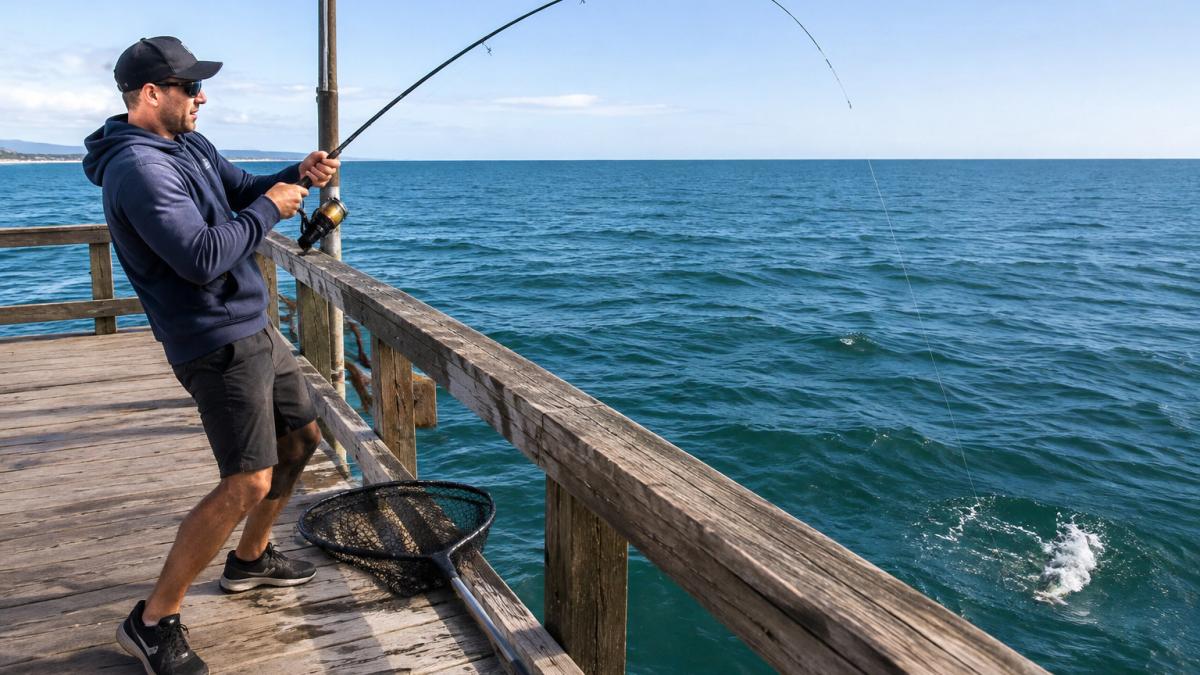
Keep a landing net within reach before you hook anything. Lower it to the water to bring the fish up, rather than lifting the fish by the line alone, which can snap light tackle.
Use your rod to control the fish as it approaches. Keep the rod tip up and let the drag do the work when a fish runs. Avoid reeling hard against a strong surge.
A sand spike is a useful accessory for holding your rod steady while you land a fish, retrieve line or rest between casts. The Jarvis Walker Metal Sand Spike 110cm is galvanised steel and easy to set up, and it keeps your rod secure.

Book Your Gear Fitting and Get Your Pier Setup Sorted
Choosing the best fishing rod for pier fishing comes down to how you fish, where you fish and what you want to catch. A medium power rod of around 2.7 to 3 metres covers most pier situations, and a matched combo makes the first purchase simpler.
If you want help narrowing the choice, visit our team at Fergo's Tackle World. We can talk through your target species, your casting needs and your budget, and point you to the right setup. book a gear fitting and we will help you pick a rod that suits your pier and your style.
Frequently Asked Questions
What length fishing rod is best for pier fishing?
Most anglers fishing from a pier do well with a rod between 2.1 and 2.7 metres. A shorter rod of around 2.1 metres gives you more control when fish are pulled up close to the boards, while a 2.7-metre rod, such as the Okuma Wave Power 902M 5-7kg, adds casting distance to reach deeper water. Longer rods cast further but are heavier to hold for long sessions, so match the length to how far you need to cast and how comfortably you can handle it.
Is a spinning rod or a surf rod better for pier fishing?
A spinning rod suits most pier fishing because it balances casting distance, sensitivity and ease of use for beginners. Surf rods are longer and built for throwing baits a long way from the beach, which can be useful on wide piers but is often more rod than you need. Choose a spinning rod in a medium power rating if you want one setup for lures and baits.
What size reel should I use with a pier fishing rod?
A 4000-size spinning reel is a practical choice for most pier fishing rods in the 2.1 to 2.7 metre range. It holds enough line for typical pier species and balances well with a medium power rod. The Shimano Sienna 4000 in the Shimano Sienna 702 Heavy Spin Combo is an example of a reel in this size, with a 10-year warranty and an 8.5kg drag.
How do you land a fish from a pier safely?
Keep your line tight and let the rod's bend do the work rather than horsing the fish up. When the fish is close to the pier, lower a landing net or use a gaff only if local rules allow it, and never lift a fish by the line. Pier edges are high and slippery, so keep your footing firm, keep children well back, and check the pier's rules before using a gaff.
Australian Fisheries Management Authority guidance on recreational fishing


