


Table of Contents
- What to Expect from Professional Fishing Rod Repair Services
- Repair or Replace? A Decision Matrix for Damaged Rods
- How to Fix a Broken Fishing Rod Tip: A Step-by-Step Guide
- Fishing Rod Guide Replacement Cost and What It Covers
- Fishing Reel Maintenance Services and Why They Matter
- DIY vs Professional Rod Repair: Tools, Techniques, and Trade-offs
- Protecting Your Rod: Storage, Care, and Corrosion Prevention
- Frequently Asked Questions
Last Updated: September 29, 2026
What to Expect from Professional Fishing Rod Repair Services
Searching for fishing rod repair services often means a rod you love has failed, or you want to stop it failing again. At Fergo's Tackle World, we've helped anglers with their gear for decades: most damage is fixable, but not all of it is worth fixing.

Professional rod repair covers a defined set of jobs: replacing broken tip-tops, rebuilding or replacing fishing rod guides, repairing ferrules, reseating or replacing a reel seat, restoring cork handles, and reinforcing a rod blank where structural damage has started.
Repair or Replace? A Decision Matrix for Damaged Rods
The rule most anglers should apply: if the repair costs more than roughly a third of the rod's replacement value, replace it. That single test resolves most decisions before you pick up the phone.
| Damage Type | Typical Fix | Worth Repairing? | Why |
|---|---|---|---|
| Broken tip-top | Replace tip-top, rewrap | Almost always | Cheap, fast, restores full function |
| Single cracked guide | Guide replacement | Yes | Low cost, prevents line damage |
| Multiple guides damaged | Full guide set rebuild | Usually | Cost climbs, but blank is often fine |
| Ferrules loose or cracked | Ferrule repair or re-splint | Sometimes | Depends on blank condition |
| Reel seat loose | Reseat or replace | Yes | Structural, affects every cast |
| Cracked mid-blank | Splinting or section replacement | Rarely | Compromises rod spine and action |
| Shattered butt section | Full rebuild | No | Cost exceeds value in most cases |
A rod with a sound blank and damaged hardware is nearly always worth saving. A rod with a compromised blank is not, no matter how good the guides are.
How to Fix a Broken Fishing Rod Tip: A Step-by-Step Guide
Fixing a broken rod tip is the one repair most anglers can do at home. You need a replacement tip-top sized to your rod, a heat gun or lighter, epoxy resin, thread, and a steady hand.
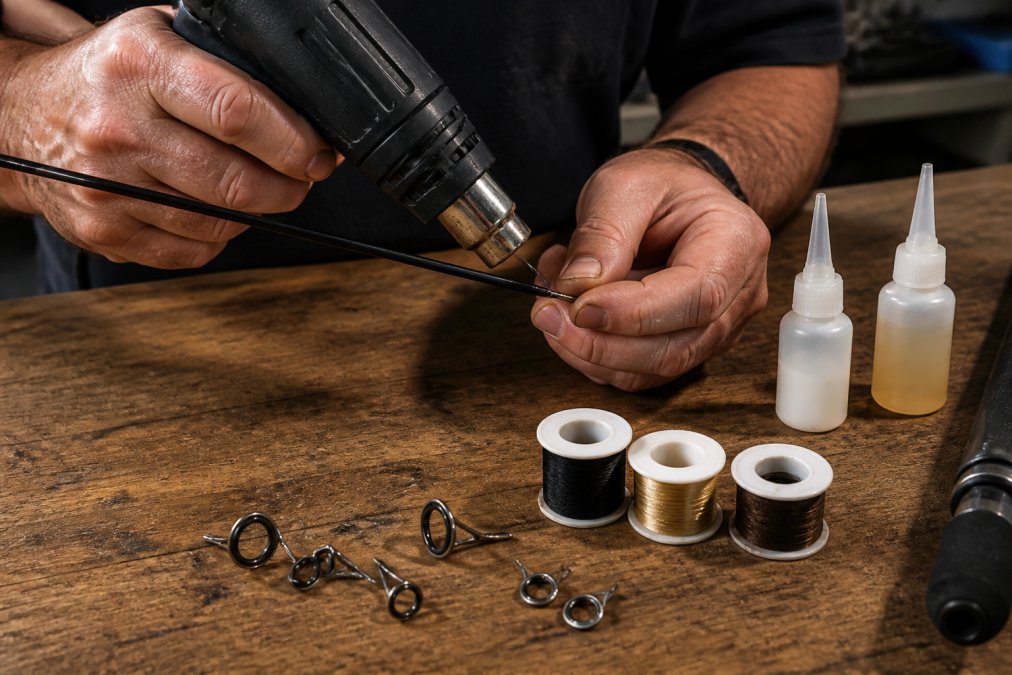
What you'll need:
- Replacement tip-top matched to your rod's tip diameter
- Heat gun or lighter
- Two-part epoxy resin
- Rod-building thread
- Fine sandpaper
- Rubbing alcohol and a clean cloth
Fishing Rod Guide Replacement Cost and What It Covers
Guide replacement is a common paid rod repair, and the price swings widely depending on how many guides are involved, what they're made of, and whether the blank underneath is damaged. Most tackle shops and independent rod builders quote per guide, so it pays to understand what you're charged for.
What drives the cost:
- Number of guides. A full set rebuild on a rod might involve 8-10 guides plus the tip-top, each removed, cleaned, aligned, wrapped and epoxied.
- Guide material. Stainless steel frames with aluminium oxide rings are the budget option. SiC rings resist braid abrasion far better. Torzite is lighter and smoother again, and priced accordingly.
- Blank condition. If corrosion or abrasion has damaged the blank under a guide foot, the repairer may need to reinforce or splint that section first, a separate job with a separate cost.
- Thread and finish. Colour-matched thread and a proper epoxy finish take time; a cheap job with mismatched thread and a thin coat fails sooner.
- Rod type. Heavy offshore rods with large double-foot guides take longer than a light bream spin rod with single-foot guides.
What's typically included:
- Removal of the damaged guide and old thread wrapping
- Inspection of the blank underneath for abrasion or corrosion
- New guide fitted and aligned to the rod's spine
- Fresh thread wrapping and epoxy coating
- Curing time before the rod is fishable
What's often not included, and worth asking about upfront:
- Reel seat inspection or repair
- Cork handle restoration
- Ferrule servicing
- Cosmetic refinishing of the blank
- Return postage if you're posting the rod in
Fishing Reel Maintenance Services and Why They Matter
Fishing reel maintenance services exist because reels fail slowly, then all at once.
DIY vs Professional Rod Repair: Tools, Techniques, and Trade-offs
Material-specific repair techniques
- Fibreglass. The most forgiving material: it tolerates more heat during tip-top removal, flexes without shattering, and accepts epoxy readily, making it the ideal learning platform for DIY guide and tip-top work. The trade-off is weight, repairs add mass a fibreglass blank carries less gracefully than graphite.
- Graphite (carbon fibre). High-modulus graphite is stiff, light and unforgiving. It conducts heat fast, so a heat gun held too long will delaminate the resin matrix and destroy the blank, and it shatters rather than bends under impact. DIY is fine for tip-tops and single guides if you work slowly with the lowest effective heat, but any blank damage should go to a professional.
- Composite (graphite/fibreglass blends). Common in mid-range rods and somewhere between the two: treat it like graphite for heat and fibreglass for flex, and always err on the side of less heat.
- Bamboo. A niche material now, but still fished. Bamboo repairs are a specialist craft, splitting, gluing, and re-planing are not DIY jobs. Seek out a rod builder with bamboo experience.
Tools that actually matter
- Heat gun with adjustable temperature. A variable-temperature heat gun beats a lighter every time, use the lowest setting that softens the adhesive without cooking the blank. A lighter gives no control and is the leading cause of DIY blank damage.
- Rod-building thread. Size A or D nylon thread, matched to your guide foot. Cheap sewing thread will not hold under load.
- Two-part epoxy. Use a slow-cure rod-building epoxy, not five-minute hardware-store epoxy. Slow cure gives you working time to align the guide and produces a more durable bond.
- Fine sandpaper (400-600 grit). For lightly keying the blank before epoxy. Too coarse and you'll gouge the surface.
- Rubbing alcohol and lint-free cloth. For cleaning before bonding. Any oil or salt residue weakens the bond.
- A rod dryer or turning motor. Not essential for a single tip-top, but invaluable for a full guide set. It keeps the epoxy rotating while it cures so it doesn't sag.
Where DIY wins
- Broken tip-tops
- Single guide replacement
- Reel greasing and basic cleaning
- Cork handle cleaning
- Minor thread wrap repairs
- Replacing a hook keeper
Where professional wins
- Blank fractures or splinting
- Full guide set rebuilds
- Ferrule repair
- Reel seat replacement
- Rod extension or splicing
- Any repair where alignment matters
- Bamboo or vintage rod restoration
Curing time is not negotiable, rushing it is the biggest cause of failed DIY repairs. A wrap that looks set after an hour is not set; give it the full cure time specified on your epoxy, ideally overnight before fishing.
Protecting Your Rod: Storage, Care, and Corrosion Prevention
Most rod damage happens between trips, not during them. Proper storage prevents the abrasion, corrosion and impact damage that lead to repairs.
Beyond storage, the basics of rod care:
- Rinse rods and reels with fresh water after every saltwater session
- Dry completely before storing
- Check guides for cracks after every trip
- Loosen drags before storage to protect drag washers
- Store rods horizontally or vertically, never leaning on the tip
Frequently Asked Questions
Is it worth repairing a broken fishing rod?
It depends on the rod's value and the damage. A snapped tip or a single broken guide is usually worth fixing, especially on quality rods. For a cheap rod with a shattered mid-section, replacement often makes more sense. Use our decision matrix: if repair costs exceed half the rod's replacement price, or if the damage affects the rod blank's structural integrity, replace it.
Can a snapped fishing rod tip be fixed?
Yes, a snapped tip can often be repaired by trimming the broken section and fitting a new tip-top guide. This shortens the rod slightly, which may affect its action. For a clean break near the tip, the fix is straightforward. If the break is lower down, a professional may need to splint the rod blank. Learn how to fix a broken fishing rod tip in our step-by-step guide above.
What is the average cost of professional fishing rod repairs?
These prices vary by service provider and rod complexity. Always ask for a quote before committing, and compare it to the cost of a new rod.
Do tackle shops offer rod repair services?
Many tackle shops offer basic rod repair services, such as tip-top replacement and guide wrapping. Some also provide reel maintenance services. It's best to call ahead and ask what they can handle. For complex repairs like blank splinting or custom rod building, they may refer you to a specialist. Fergo's Tackle World offers expert advice and can help you find the right solution for your gear.


